Interactive guide to the endocrine system
Use this interactive to explore the glands in the endocrine system.
The endocrine system is a network of glands that produce hormones to regulate various bodily functions. Understanding how it works helps us see how these glands and hormones work together to maintain balance and respond to changes in our bodies. Use this resource to learn about the endocrine system, including a culturally responsive model for managing endocrine-related complications during pregancy.
The endocrine system (or hormonal system) consists of a network of endocrine glands that produce hormones to regulate crucial processes in the body like growth, metabolism, and mood. Together, these glands help to maintain balance in the body and make sure that we can respond effectively to internal and external changes.
A diagram of the endocrine system in the female and male bodies, with key organs labelled.
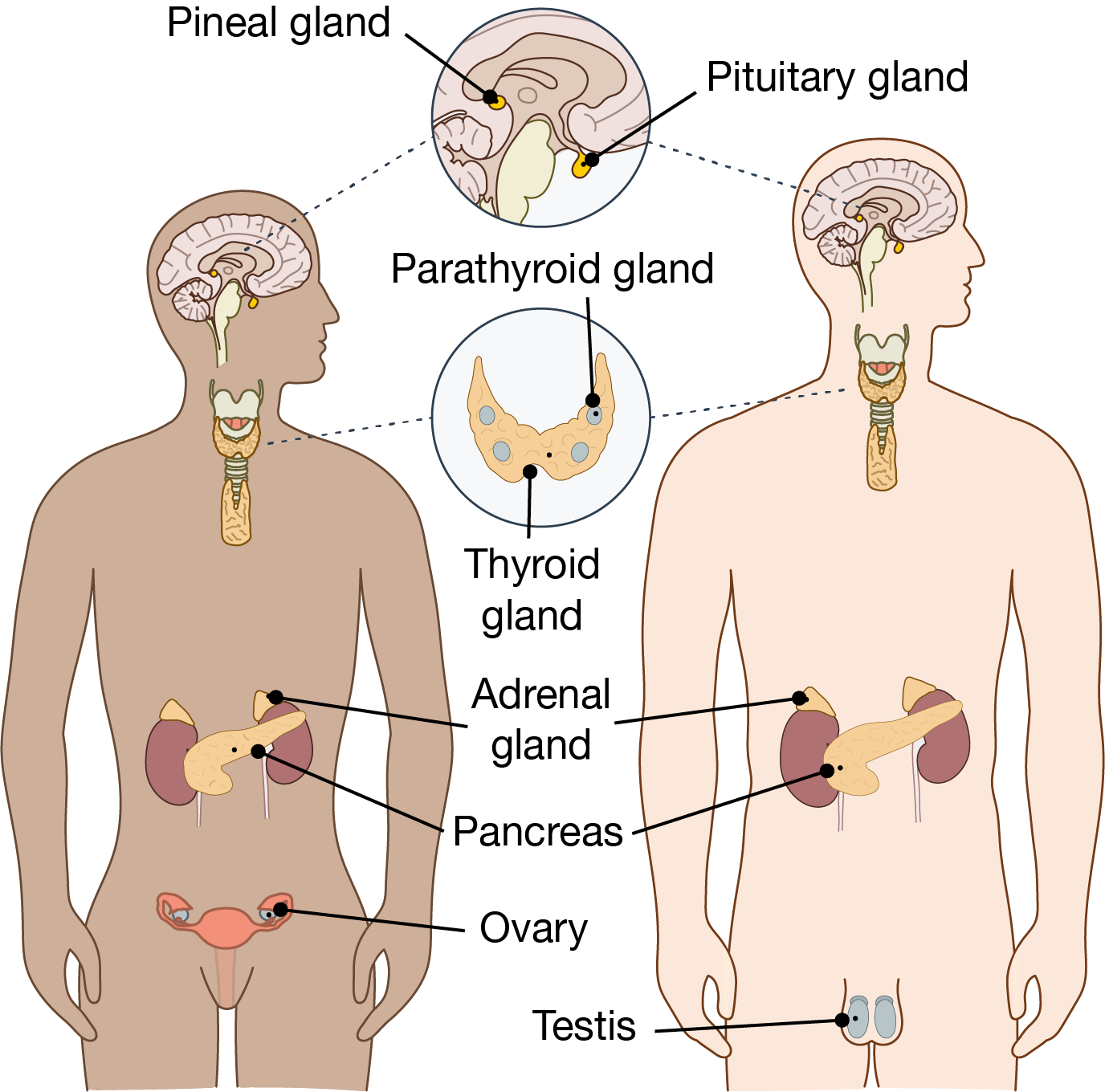
The endocrine system
Hormones are chemical messengers produced by glands in the endocrine system. They allow your glands to communicate with different parts of your body to make sure your organs and systems are working together harmoniously.
Hormones are released into your bloodstream, where they can then travel to organs and tissues all around the body.
The endocrine glands, their location, functions and examples of hormones involved are shown in the table.
| Gland | Location | Function | Hormones |
|---|---|---|---|
| Hypothalamus | Base of the brain | Regulates body temperature, hunger, thirst; controls the pituitary gland | Corticotropin-releasing hormone (CRH), thyrotropin-releasing hormone (TRH) |
| Pituitary | Below the hypothalamus | Controls other endocrine glands; regulates growth and development | Growth hormone (GH), adrenocorticotropic hormone (ACTH) |
| Thyroid | Neck, below the Adam’s apple | Regulates metabolism and energy use | Thyroxine (T4), triiodothyronine (T3) |
| Parathyroid | On the thyroid gland | Regulates calcium levels in the blood | Parathyroid hormone (PTH) |
| Thymus | Upper chest, behind the sternum | Develops immune system cells | Thymosin |
| Adrenal | On top of each kidney | Manages stress and regulates metabolism and electrolyte balance | Cortisol, adrenaline |
| Pancreas | Upper abdomen, behind the stomach | Regulates blood sugar levels | Insulin, glucagon |
| Ovaries | Pelvis, on either side of the uterus | Produces sex hormones for reproduction | Estrogen, progesterone |
| Testes | Scrotum | Produces sex hormones and sperm | Testosterone |
| Pineal | Middle of the brain | Regulates the sleep–wake cycle | Melatonin |
Watch this video for an overview of how hormones work.
Alongside growth and sexual maturity, this system regulates everything from your sleep to the rhythm of your beating heart, exerting its influence over each and every one of your cells.
The endocrine system relies on interactions between three features to do its job: glands, hormones and trillions of cell receptors.
Firstly, there are several hormone-producing glands: three in your brain, and seven in the rest of your body. Each is surrounded by a network of blood vessels, from which they extract ingredients to manufacture dozens of hormones. Those hormones are then pumped out in tiny amounts, usually into the bloodstream.
From there, each hormones needs to locate a set of target cells in order to bring about a specific change. To find its targets, it's helped along by receptors, which are special proteins inside or on the cell's surface. Those receptors recognise specific hormones as they waft by and bind to them.
When this happens, that hormone-receptor combination triggers a range of effects that either increase or decrease specific processes inside the cell to change the way that cell behaves.
By exposing millions of cells at a time to hormones in carefully-regulated quantities, the endocrine system drives large-scale changes across the body.
Take, for instance, the thyroid and the two hormones it produces, triiodothyronine and thyroxine. These hormones travel to most of the body's cells, where they influence how quickly those cells use energy and how rapidly they work. In turn, that regulates everything from breathing rate to heartbeat, body temperature, and digestion.
Hormones also have some of their most visible—and familiar—effects during puberty. In men, puberty begins when the testes begin secreting testosterone. That triggers the gradual development of the sexual organs, makes facial hair sprout, and causes the voice to deepen and height to increase.
In women, estrogen secreted from the ovaries signals the start of adulthood. It helps the body develop, makes the hips widen, and thickens the womb's lining, preparing the body for menstruation or pregnancy.
An enduring misconception around the endocrine system is that there are exclusively male and female hormones. In fact, men and women have estrogen and testosterone, just in different amounts.
Both hormones play a role in pregnancy, as well, alongside more than 10 other hormones that ensure the growth of the fetus, enable birth, and help the mother feed her child.
Such periods of hormonal change are also associated with fluctuations in mood. That's because hormones can influence the production of certain chemicals in the brain, like serotonin.
When chemical levels shift, they may cause changes in mood, as well. But that's not to say that hormones have unlimited power over us.
They're frequently viewed as the main drivers of our behaviour, making us slaves to their effects, especially during puberty. But research shows that our behaviour is collectively shaped by a variety of influences, including the brain and its neurotransmitters, our hormones, and various social factors.
The primary function of the endocrine system is to regulate bodily processes, not control us. Sometimes disease, stress, and even diet can disrupt that regulatory function, however, altering the quantity of hormones that glands secrete or changing the way that cells respond.
Diabetes is one of the most common hormonal disorders, occurring when the pancreas secrets too little insulin, a hormone that managed blood sugar levels. And hypo- and hyperthyroidism occur when the thyroid gland makes too little or too much thyroid hormone.
When there's too little thyroid hormone, that results in a slowed heart rate, fatigue and depression, and when there's too much thyroid hormone, weight loss, sleeplessness, and irritability.
But most of the time, the endocrine system manages to keep our bodies in a state of balance. And through its constant regulation, it drives the changes that ultimately help us become who we are.
We will look at the hypothalamus, pituitary gland and pancreas in more detail, but you can explore the Further resources at the end of this page to learn more about the other glands and how they function.
Ever heard of the gut–brain connection? Serotonin, a hormone that helps regulate mood, is also found in the digestive system, highlighting this connection.
The hypothalamus is a small but crucial part of the brain located at its base. It acts as a bridge between the nervous and endocrine systems, helping to regulate body temperature, hunger, thirst, and emotions.
The hypothalamus monitors the body's internal environment and responds by releasing hormones that communicate with the pituitary gland. These hormones ensure the body maintains balance and reacts properly to changes, like stress or external temperature shifts. You can learn more about homeostasis and the body's balancing act on the Homeostasis page.
The pituitary gland is only about the size of a pea, yet it has a powerful influence on many body systems and processes.
The pituitary gland, known as the "master gland," sits just below the hypothalamus. Despite its small size, it plays a significant role in controlling other endocrine glands.
A diagram of a person's brain, with a zoomed-in look near the hypothalamus and pituitary gland. These structures are located at the base of the brain, at the top of the brainstem. The thalamus sits under the cerebrum. The hypothalamus is just underneath it. There is a funnel-shaped empty space called the infundibulum, and under that is the pituitary gland. The pituitary gland consists of two regions: the anterior and posterior pituitary.
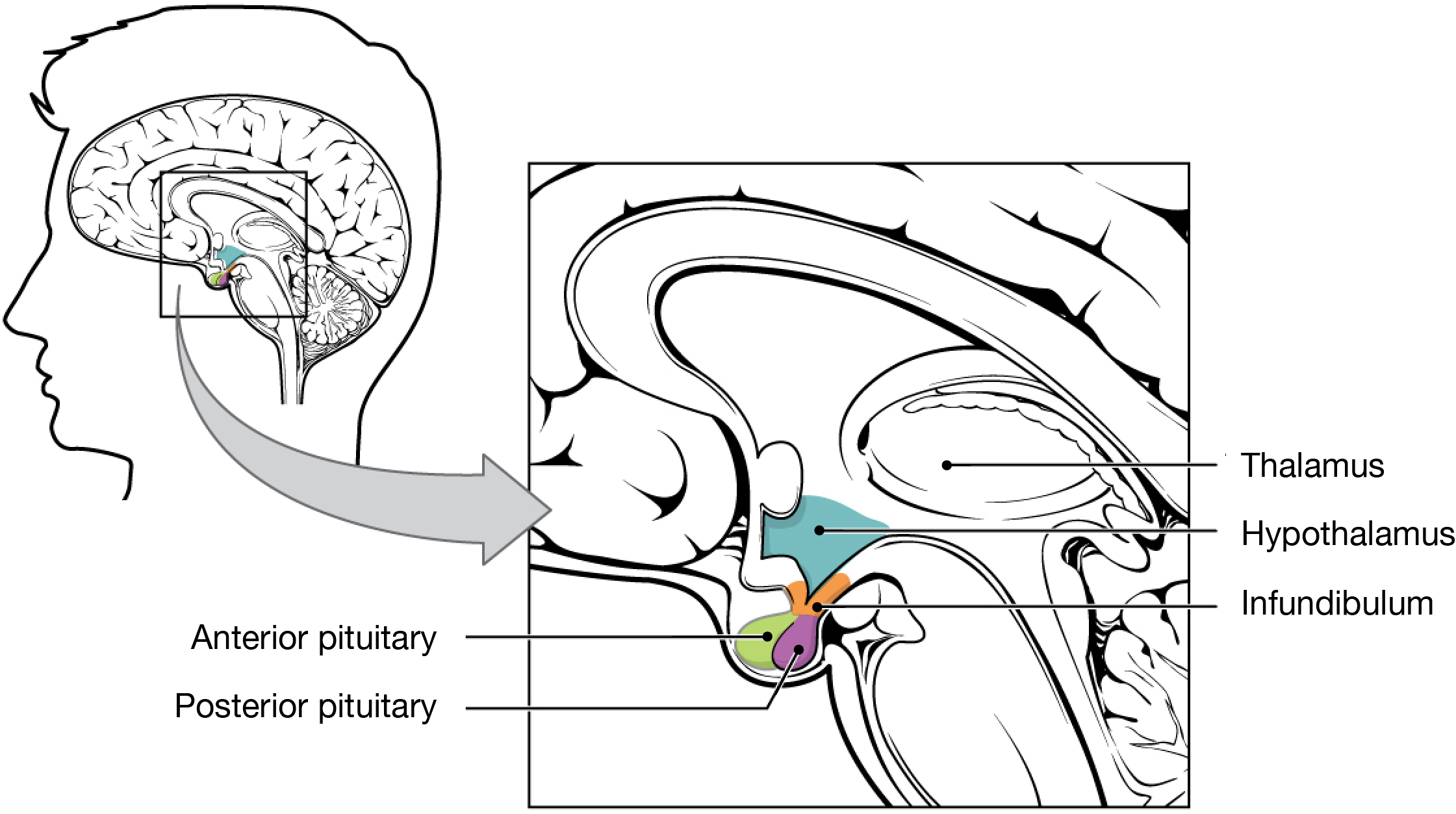
The hypothalamus and pituitary gland
The pituitary gland releases hormones that influence growth, metabolism, and reproduction. For example, human growth hormone (HGH) helps control how the body grows, while adrenocorticotropic hormone (ACTH) stimulates the adrenal glands to produce cortisol, a vital stress hormone.
Together, the hypothalamus and pituitary gland coordinate many essential bodily functions. They ensure that hormones are released in the right amounts and at the right times, keeping the body's systems running smoothly. This teamwork between the brain and the endocrine system is key to overall health and wellbeing.
The pancreas is a vital organ located in the upper abdomen, behind the stomach.
A diagram of the pancreas and surrouding organs. The stomach is shown, leading into the duodenum. Branching off the duodenum is the pancreas with the head and tail of this organ labelled. The liver is also shown with the gallbladder. The tubes leading out of the gallbladder and pancreas combine to form the common bile duct.
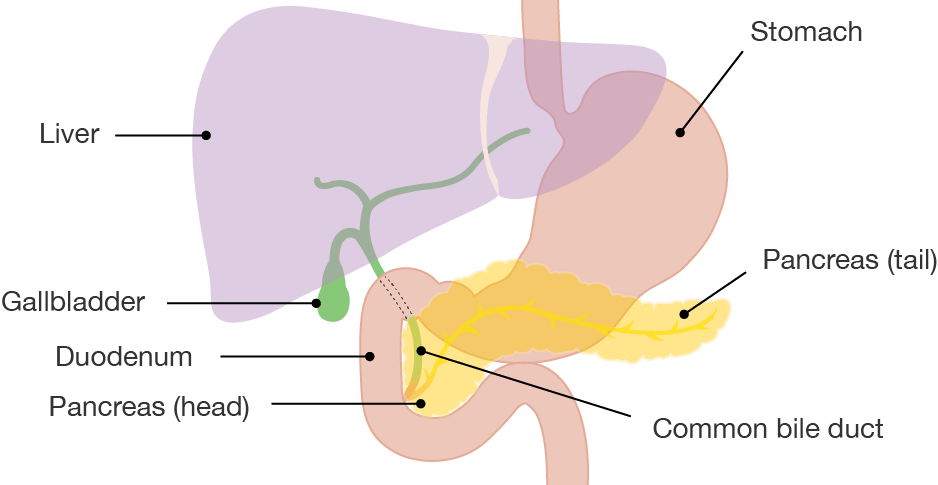
The pancreas
It has two main functions:
To perform its function in the endocrine system, the pancreas makes the hormone insulin, which lowers blood sugar, and glucagon, which raises it, helping maintain balance.
The pancreatic role in digestion and blood sugar control is essential for keeping the body healthy. You can learn more about blood sugar regulation in Homeostasis.
You can use this interactive model to see how the pancreas interacts with the duodenum, a part of the digestive system.
Pancreas and duodenum by Ebers via Sketchfab, licensed under Standard Sketchfab License
Indigenous knowledges in life science
Aboriginal and Torres Strait Islander women experience a high risk of complications during pregnancy like heart disease and type II diabetes. Type II diabetes is a metabolic disease where the pancreas does not produce enough insulin to help the body regulate blood glucose levels.
Research led by Aboriginal women, including Karrina DeMasi (Barkandji), aims to develop a culturally responsive model of care for Aboriginal women experiencing cardiometabolic complications during pregnancy. This involves identifying pathways for access to knowledge, services and care. The project also involves bringing together health services, systems and leaders in maternal cardiometabolic research to address a key healthcare inequality.
See how well you understand the endocrine system and its function with a quick quiz.
Read the scenario and use the information provided to answer the questions in the quiz.
Researchers in Switzerland conducted a study to determine reference values for the key hormones involved in the menstrual cycle. This graph shows the change in progesterone levels (in ng/mL) in blood serum over a 29-day cycle. The solid line represents the median concentration and the dashed lines represent the 95% confidence interval.
Line graph with three lines on the graph, a solid line labelled "Median" and two dashed lines labelled "95% confidence interval". The x-axis is labelled "Time of cycle", starting from 0 and ending at 30, with intervals of 2. The y-axis is labelled "Serum progesterone levels", starting from 0 and ending at 20, with intervals of 2. In the graph, the "Median" line begins at day 0 with a progesterone level of 0.5. It remains low until about day 15, where it starts to increase. The progesterone level peaks at 13.5 on day 22. Then, the level drops again to about 1.0 at day 29. The "95% confidence interval" lines show that the spread of data is very small from day 0 to around day 15. Then, as the median increases, the spread of data also increases. The data is furthest from the median at the peak progesterone concentration. The range of data values is also very high at the 29 day mark. The data is summarised in the table.
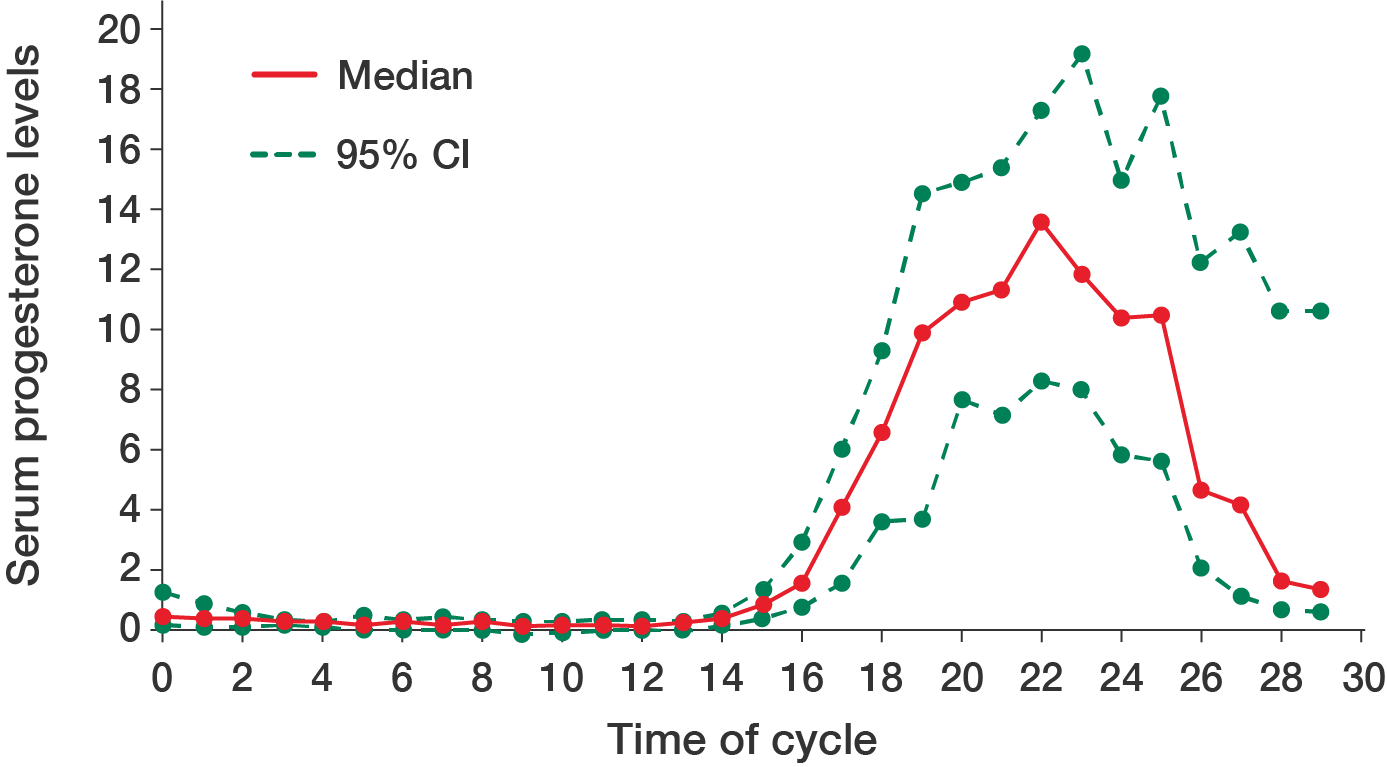
Line graph showing serum progesterone levels
Time of cycle
Median
95% CI Lower Bound
95% CI Upper Bound
0
\(1.0\)
\(0.5\)
\(1.5\)
1
\(0.5\)
\(0.0\)
\(1.0\)
2
\(0.5\)
\(0.0\)
\(1.0\)
3
\(0.5\)
\(0.0\)
\(1.0\)
4
\(0.5\)
\(0.0\)
\(1.0\)
5
\(0.5\)
\(0.0\)
\(1.0\)
6
\(0.5\)
\(0.0\)
\(1.0\)
7
\(0.5\)
\(0.0\)
\(1.0\)
8
\(0.5\)
\(0.0\)
\(1.0\)
9
\(0.5\)
\(0.0\)
\(1.0\)
10
\(0.5\)
\(0.0\)
\(1.0\)
11
\(0.5\)
\(0.0\)
\(1.0\)
12
\(0.5\)
\(0.0\)
\(1.0\)
13
\(0.5\)
\(0.0\)
\(1.0\)
14
\(1.0\)
\(0.5\)
\(1.5\)
15
\(2.0\)
\(0.5\)
\(2.5\)
16
\(4.0\)
\(1.0\)
\(4.5\)
17
\(7.0\)
\(2.0\)
\(8.0\)
18
\(9.5\)
\(3.5\)
\(14.5\)
19
\(10.5\)
\(5.0\)
\(15.5\)
20
\(11.0\)
\(7.0\)
\(18.5\)
21
\(12.0\)
\(8.0\)
\(19.0\)
22
\(13.5\)
\(9.0\)
\(19.5\)
23
\(11.0\)
\(8.0\)
\(18.0\)
24
\(10.5\)
\(7.0\)
\(15.0\)
25
\(10.5\)
\(5.5\)
\(13.5\)
26
\(4.5\)
\(2.0\)
\(12.0\)
27
\(4.0\)
\(1.5\)
\(10.5\)
28
\(1.5\)
\(0.5\)
\(10.5\)
29
\(1.0\)
\(0.5\)
\(10.5\)
30
\(1.0\)
\(0.5\)
\(10.5\)
Graph adapted from Stricker R, Eberhart R, Chevailler MC, Quinn FA, Bischof P and Stricker R (2006), 'Establishment of detailed reference values for luteinizing hormone, follicle stimulating hormone, estradiol, and progesterone during different phases of the menstrual cycle on the Abbott ARCHITECT® analyzer', Clinical Chemistry and Laboratory Medicine, 44(7):883–887, doi: 10.1515/CCLM.2006.160, licensed under CC BY-SA 4.0
Images on this page by RMIT, licensed under CC BY-NC 4.0


RMIT University acknowledges the people of the Woi wurrung and Boon wurrung language groups of the eastern Kulin Nation on whose unceded lands we conduct the business of the University. RMIT University respectfully acknowledges their Ancestors and Elders, past and present. RMIT also acknowledges the Traditional Custodians and their Ancestors of the lands and waters across Australia where we conduct our business - Artwork 'Sentient' by Hollie Johnson, Gunaikurnai and Monero Ngarigo.
More information