Fact Checking LibGuide
This Library guide lists reputable news sources and fact-checking organisations you can use to check whether a claim you want to cite actually holds up.
Selecting credible sources for your assignments enhances the quality and reliability of your work, making your arguments more persuasive and impactful. On the other hand, choosing the wrong sources can make your arguments weaker.
Find out the difference between a strong and weak argument, and what information sources are considered reliable.
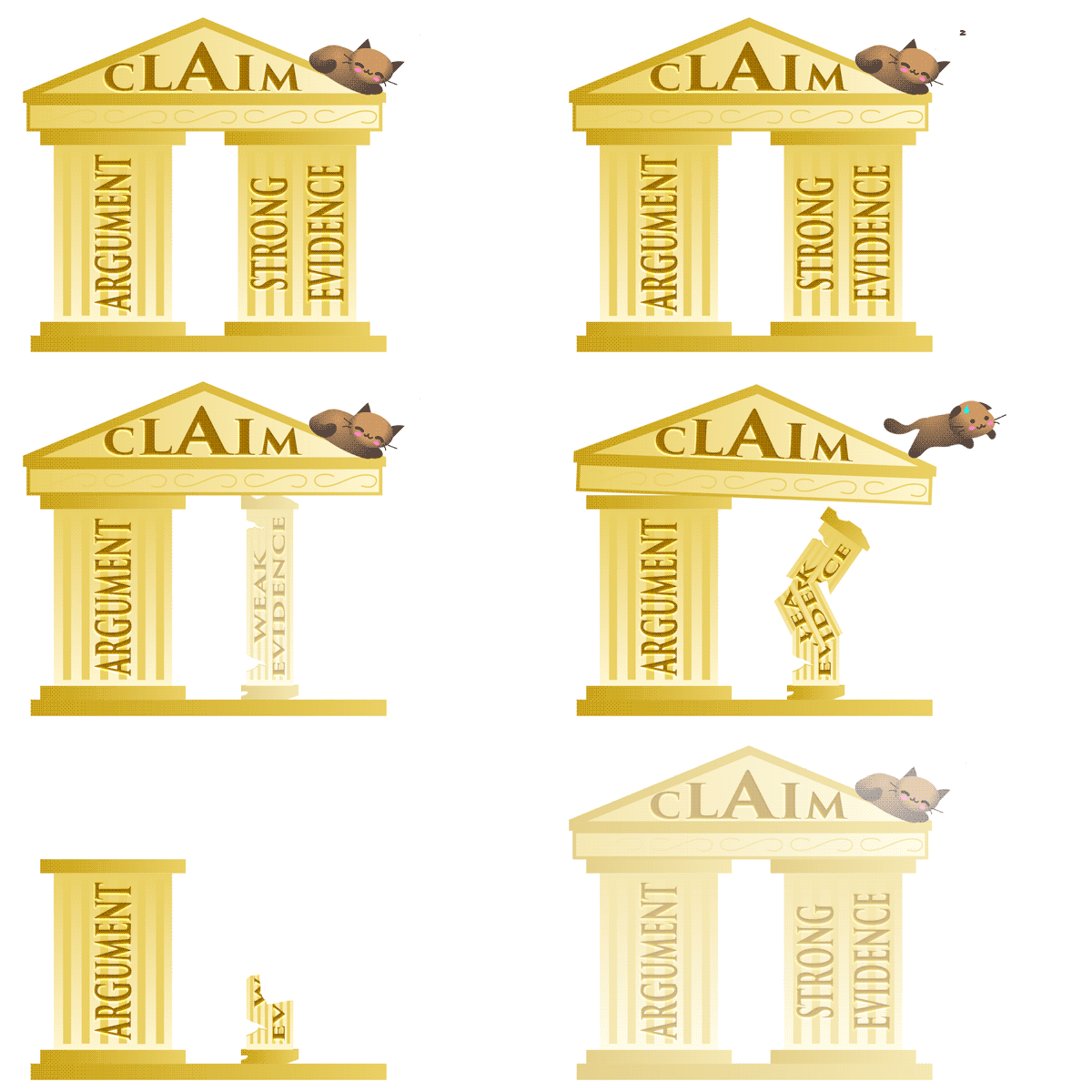
Weak arguments rely on insufficient, unreliable, or irrelevant evidence, leading to unconvincing conclusions.
Here are some, but not all, types of information sources that can weaken your work if relied upon too heavily. Understanding these can help you make more informed choices in your research.
Strong information sources provide reliable, relevant, and well-supported data that makes your work more convincing. Below are some key types of strong information sources to guide you in selecting the most effective materials for your research.
While you read books and articles or watch videos to find information for your assignments, remember to think about how the authors support their claims. Are they using evidence from reputable sources or are they relying on unchecked sources and assumptions?
Once you have found information that you would like to cite in your work, here are some techniques that can be used. In these examples, the writer will use weak points on which to base their counter arguments and strong points to support their argument.
Concession + counter claim
Example: Admittedly, there are benefits to Bako’s (2022) plan for overhauling the education system. However, they do not justify the costs that will be borne by taxpayers.
Refute with evidence
Example: Cienfuegos (2024) claims that intermittent fasting can reduce inflammation. This is despite a lack of support from recent empirical studies.
Acknowledge opposing views
Example: A number of academics (Daalman, 2021; Aronov & Weller, 2021; Stojanovski 2019) are of the view that an excess of sugar can cause hyperactivity in children, but a new study by Zapatero (2024) shows that this may not be the case.
Identify a lack of evidence
Example: Whittaker (2023) does not support their claim with evidence from a reliable source.
Comparative analysis
Example: Smith (2020) uses anecdotal evidence from a personal experience to conclude that positive education is completely ineffective. On the other hand, Christopoulos (2023) conducted a systematic review that shows that positive education can be an effective classroom tool.


RMIT University acknowledges the people of the Woi wurrung and Boon wurrung language groups of the eastern Kulin Nation on whose unceded lands we conduct the business of the University. RMIT University respectfully acknowledges their Ancestors and Elders, past and present. RMIT also acknowledges the Traditional Custodians and their Ancestors of the lands and waters across Australia where we conduct our business - Artwork 'Sentient' by Hollie Johnson, Gunaikurnai and Monero Ngarigo.
More information