Every time you charge your phone, flick a light switch or plug in a kettle, you are interacting with an electrical circuit. But what is actually happening inside it? Use this resource to learn about the key quantities used to describe and measure electricity, the calculations that connect them, and an example of how electrical phenomena are represented in Wandjina rock paintings.
Please note: This page includes an image of a Wandjina, a sacred ancestral being for Worrorra, Ngarinyin, Wunambal and Gaambera peoples of the Kimberley. The image is shared for educational purposes and may be culturally sensitive or distressing for some viewers. Please exercise care and respect when viewing it.
Electric circuits
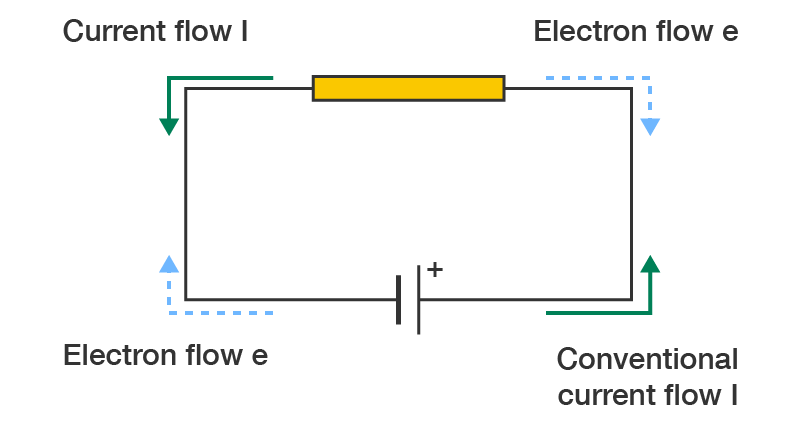
An electric circuit is a closed path that allows electric charge to flow. A simple circuit usually has a power source (such as a battery), conducting wires and one or more components (such as a light globe or motor). A circuit must be closed (with no breaks in the path) for current to flow.
Electricity also occurs naturally in the environment. Lightning is a large electrical discharge caused by the build-up of charge in clouds, while smaller static charges can build up on objects and discharge as a spark.
The direction of current we use in circuit diagrams is called conventional current flow. It flows from the positive terminal of the battery, around the circuit, to the negative terminal.
In reality, the moving charges in a metal wire are electrons (\(\text{e}^{–}\)). Electrons flow from the negative terminal to the positive terminal, in the opposite direction to conventional current. If you want to read more about electrons, check out this page.
Electrons all carry the same tiny amount of negative charge, so the total charge that flows in a circuit depends on how many electrons move past a point. Since the charge on a single electron is so small, electrical charge is usually measured in a large amount called a coulomb \(\text{C}\), rather than counting individual electrons.
\[1\,\text{coulomb of negative charge} = 1\,\text{C} = 6.25 \times 10^{18}\,\text{electrons}\]
Current \(I\) is the rate of flow of electric charge \(q\) past a point in the circuit.
\[\text{current} = \frac{\text{charge}}{\text{time}} \quad \text{or} \quad I = \frac{q}{t}\]
where \(I\) is measured in amperes (amps) \(\text{A}\), \(q\) is measured in coulombs \(\text{C}\) and \(t\) is measured in seconds \(\text{s}\).
Example – calculating charge
Consider a torch battery that produces a current of \(\mathbf{300}\,\textbf{mA}\). Determine the total amount of charge that has flowed through the circuit if the torch has been left on for \(\mathbf{20}\,\textbf{min}\).
The appropriate equation is \(q=I\times t\).
Remember, in this equation, \(I\) needs to be in \(\text{A}\) and \(t\) needs to be in \(\text{s}\). Let's complete the conversions separately, first.
If electric charges are moving in a circuit, they must be carrying energy. A battery or generator gives electrical potential energy to these charges so they can move around the circuit and do useful work (for example, lighting a globe or turning a motor). As the charges pass through components with resistance, they give up (transfer) some of this energy.
The voltage of a battery tells us how much energy is given to each coulomb of charge inside the battery. In other words, voltage is the energy per unit of charge (where the unit of charge is a coulomb \(\text{C}\)), measured in volts \(\text{V}\). One volt means that \(1\) joule (\(\text{J}\)) of energy is transferred to each coulomb of charge. For example, a \(6\,\text{V}\) battery transfers \(6\,\text{J}\) of energy to each coulomb of charge. Voltage is also called electromotive force (EMF).
When charges move through any component in a circuit and transfer energy to it, the energy transferred \(E\) per coulomb of charge \(q\) is called the potential difference (PD) across that component. Potential difference is also measured in volts, and is given by:
\[\text{voltage} = \frac{\text{energy}}{\text{charge}} \quad \text{or} \quad V = \frac{E}{q}\]
where \(V\) is in volts \(\text{V}\), \(E\) is in joules \(\text{J}\) and \(q\) is in coulombs \(\text{C}\).
In these introductory calculations, you may see all three terms used to refer to voltage – the distinctions between them matter more in advanced circuit analysis.
Since \(E = V \times q\) and \(q = I \times t\), we can combine them to obtain the equation:
\[E = V \times I \times t\]
Example – calculating energy
The potential difference across a torch globe is found to be \(\mathbf{2.7}\,\textbf{V}\). The current flowing through it is \(\mathbf{0.2}\,\textbf{A}\).
Determine how much charge flows through the torch globe in \(\mathbf{1}\) minute.
The relevant equation is \(q=I\times t\).
\[\begin{align*} q & = I \times t \\[6pt]
& = 0.2 \times 60\text{s}\\[6pt]
& = 12\text{C}\end{align*}\]
In \(1\) minute, \(12\,\text{C}\) of charge flows through the globe.
Calculate the amount of energy lost by this charge.
The potential difference of \(2.7\,\text{V}\) tells us that each coulomb of charge loses \(2.7\,\text{J}\) of electrical potential energy as it passes through the globe. This energy appears mainly as heat and light. We can calculate the energy loss using \(V=\dfrac{E}{q}\) by first rearranging it to make \(E\) the subject.
\[\begin{align*} E & = q\times V \\[6pt]
& = 12\times2.7\\[6pt]
& = 32.4\,\text{J}\end{align*}\]
When \(12\,\text{C}\) is flowing through the globe, \(32.4\,\text{J}\) of energy is lost.
Power \(P\)
Power \(P\) is the rate of energy transfer.
\[\text{power} = \frac{\text{energy}}{\text{time}} \quad \text{or} \quad P = \frac{E}{t} = \frac{V \times I \times t}{t} = V \times I\]
where \(P\) is measured in joules per second \(\text{J/s}\) or watts \(\text{W}\), where \(1\,\text{W}=1\,\text{J/s}\).
Indigenous knowledges in physics
The Wandjina, the natural world and the spiritual world
Natural electrical phenomena, such as lightning, have long been observed and interpreted by Aboriginal and Torres Strait Islander peoples in ways that connect the environment, weather and culture.
For the Woddordda, Ngarinyin, Wunambal and Gaambera peoples of the Kimberley region of Western Australia (the Wanjina Wunggurr community), the Wandjina embodies fertility and rain, and are considered one of the most important Creator Beings and the ancestors of today’s Traditional Owners. The homes of Wandjina are treated with respect and as sacred places.
Each Wandjina has a name. Their creative deeds are known in narratives and songs. Some Wandjina images are repainted, or more accurately, refreshed by members of the Wanjina Wunggurr community to demonstrate respect and reciprocity between the Wandjina and humans, and thus to ensure the refreshing of Wanjina Wunggurr Country and the resources within it (Woolagoodja, 2020, p. 52).
Wandjina images are not rock 'art', but rather, the Wandjina have, according to the elders, “put themselves in the cave” (Eewaambood, Mrs Janet Oobagooma, as cited in Mangolamara et al., 2018, p. 9) following their creative journey and finding their final home. The refreshing of the Wandjina in their home is an intimate act between the man painting and the Wandjina; it is not to copy the Wandjina but to engage with the Wandjina and that is why the Wandjina image evolves over time. As the late Mr Yornadaiyn Woolagoodja explained about the act of refreshing: "The Wandjina, he draws you towards him, pulls you into him and that image acknowledges what you are going to do to him. He gives you encouragement to do that thing. ….when he looks at you, that image, he looks at you and he tells you, ‘You are the right person to paint me.’ There are no words, it is a feeling that I have. His leeyaan makes him know that he has the right person to paint him. The Wandjina is happy." (Woolagoodja, 2020, p. 192)
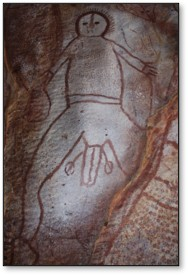
Wandjina rock painting, from We Are Coming to See You. Image reused with permission from the Dambimangari Aboriginal Corporation, Wunambal Gaambera Aboriginal Corporation and Wilinggin Aboriginal Corporation.
Wandjina are very often associated with clouds, lightning and rain. There are Wandjina images whose "eyes are the eyes of the storm and the nose is the power of the storm" (Leah Umbagai, as cited in Mangolamara et al., 2018, p. 131).
Some Wandjina have four or five or six fingers or toes, which represents different kinds of lightning and stages of a storm. For example, "Malangiddin, bolt lightning. This is the lightning when it is starting up; Jandaddee is when the lightning is finishing off. When lightning starts it is from the Wandjina’s balls, they are hitting themselves and making light. A man, mabarn can do that, daadd. ‘He displayed himself with the lightning’, that is what it means, daadd. You can get a stick and if lightning is coming straight you can hit it but you will get a shock." (Eewaambood, as cited in Mangolamara et al., 2018, p. 138)
While this cultural understanding should not be treated as a direct equivalent of modern electrical theory, it provides an opportunity to reflect on how people observe, describe and make meaning from electrical phenomena in the environment.
We would like to acknowledge and thank Kate Sutton (Wunambal Gaambera Aboriginal Corporation), Dr Kim Doohan and Leah Umbagai (Dambimangari Aboriginal Corporation, Wunambal Gaambera Aboriginal Corporation and Wilinggin Aboriginal Corporation), and the Indigenous Science Committee (School of Science, RMIT University) for their consultation, which has helped shape this example. For further information, please explore the following resources:
Mangolamara, S., Karadada, L., Oobagooma, J., Woolagoodja, D. & Karadada, J. (2018) Nyara Pari Kala Nigaru (Gaambera), Gadawara Ngyaran-Gada (Wunambal), Inganinja Gubadjoongana (Woddorda) We Are Coming to See You (K. Doohan, Comp.). Derby, Western Australia : Dambimangari Aboriginal Corporation & Wunambal Gaambera Aboriginal Corporation.
Woolagoodja, Y. (2020). Yornadaiyn Woolagoodja. Magabala Books.
Blundell, V., Doohan, K., Vachon, D., Allbrook, M., Jebb, M. A., & Bornman, J. (2017). Barddabardda Wodjenangorddee: We’re telling all of you: The creation, history and people of Dambeemangaddee Country. Dambimangari Aboriginal Corporation.
Calculate the amount of charge that would flow through a:
\(5\,\text{mA}\) pocket calculator in \(10\,\text{min}\).
\(200\,\text{A}\) car starter motor in \(5\,\text{s}\).
\(400\,\text{mA}\) light bulb in \(1\,\text{h}\).
\(3\,\text{C}\)
\(1000\,\text{C}\)
\(1440\,\text{C}\)
\(1.7\times10^{26}\) electrons pass a point in a wire each second. Calculate the electric current that this represents.
\(2.7\times10^{7}\,\text{A}\)
A charge of \(5\,\text{C}\) flows from a battery through an electric water heater and delivers \(100\,\text{J}\) of heat to the water. Calculate the voltage of the battery.
\(20\,\text{V}\)
A portable speaker is powered by a \(9\,\text{V}\) battery. Calculate the amount of energy transferred from each coulomb of charge as it passes through the circuit that drives the speaker.
\(9\,\text{J}\)
A car motor is powered by a \(12\,\text{V}\) battery. Determine the amount of charge that must have flowed through the circuit for \(2\,\text{kJ}\) of energy to be delivered to the starter motor.